
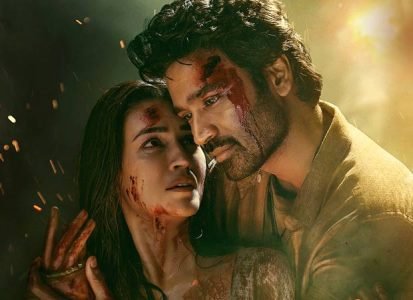
Aanand L. Rai’s latest directorial venture “Tere Ishk Mein ” presents an emotionally charged love story that explores the transformative power of romance, featuring powerhouse performances from Dhanush and Kriti Sanon. Released on November 28, 2025, this intense romantic drama earns a respectable 3.0/5 rating, showcasing both compelling storytelling and notable shortcomings.
Plot Synopsis: Love as Redemption
The film centers around Shankar Gurukkal (Dhanush), a volatile student union president at Delhi University known for his rebellious and violent tendencies. Enter Mukti Behniwal (Kriti Sanon), an ambitious PhD student whose thesis proposes that even the most violent individuals can be transformed into peaceful beings through proper intervention. When Shankar disrupts her thesis presentation with his characteristic aggression, professors dismiss her theory. Determined to prove her point, Mukti takes on the challenge of reforming Shankar himself.
What begins as an academic experiment evolves into something far more complex. Shankar gradually transforms under Mukti’s influence, developing deep feelings for her in the process. However, when reality strikes about Mukti’s true intentions and feelings, Shankar’s world turns upside down. The narrative then leaps seven years forward, setting the stage for their fateful reunion.
Direction and Screenplay Analysis
Aanand L. Rai demonstrates his storytelling prowess by opening with a pivotal moment before transitioning into flashback mode, immediately hooking viewers who are eager to understand what went wrong between the protagonists. The screenplay by Himanshu Sharma and Neeraj Yadav creates several engaging moments, though it becomes increasingly convoluted as the story progresses.
The first half showcases Rai’s directorial strength, particularly in dramatic sequences. Standout moments include Mukti’s proposition to make Shankar her subject, a tense scene where she asks a frightened man to slap Shankar, and explosive confrontations in a bar setting. The intermission point is crafted with precision, leaving audiences invested in the characters’ fate.
However, the second half reveals the film’s weaknesses. The narrative becomes overly convenient, with plot developments that strain credibility. Cinematic liberties abound, from an injured Shankar easily infiltrating a heavily secured IAS officer’s residence to questionable decisions involving a pregnant, alcoholic character being sent to high-altitude locations. The finale, while ambitious in its intentions, fails to deliver the expected emotional punch.
Stellar Performances Drive the Narrative
Dhanush delivers a tour de force performance as Shankar, masterfully balancing raw fury with vulnerable moments that reveal his character’s depth. His portrayal of a man consumed by love and later devastation showcases why he remains one of Indian cinema’s most compelling actors.
Kriti Sanon rises to the challenge with one of her most accomplished performances to date. Playing opposite a powerhouse performer like Dhanush while maintaining her character’s complexity and agency, Sanon proves her mettle as a serious dramatic actress. Her portrayal of Mukti balances intellectual determination with emotional complexity.
Prakash Raj, in a supporting role as Shankar’s father Raghav, delivers memorable scenes that add gravitas to the second half. Tota Roy Chowdhury surprises audiences familiar with his charming father role from “Rocky Aur Rani Kii Prem Kahaani,” showcasing his versatility as Yashwant Behniwal. Priyanshu Painyuli provides solid support as Ved, Shankar’s loyal friend, while Viineet Kumar Singh makes a notable impact in his special appearance.
Technical Excellence and Musical Brilliance
A.R. Rahman’s musical composition significantly enhances the film’s emotional impact. While the much-appreciated title track receives limited screen time, songs like “Jigar Thanda” (both versions), “Chinnaware” (a complete Tamil track in a Hindi film), and “Ladki Jaisi” leave lasting impressions. “Awaara Angaara” and “Usey Kehna” are well-integrated into the narrative, while Rahman’s background score perfectly complements the film’s dramatic tone.
Tushar Kanti Ray’s cinematography maintains consistency throughout, while Nitin Zihani Choudhary’s production design strikes the right balance between appeal and realism. The costume design deserves special mention – Rushi Sharma and Manoshi Nath create stylish looks for Kriti Sanon, while Kavya Sriram’s designs for Dhanush effectively represent his character’s evolution.
Sunil Rodrigues ensures the action sequences remain grounded without excessive violence, though the VFX work by RedChillies.VFX could have been more polished in certain scenes. The editing by Hemal Kothari and Prakash Chandra Sahoo needed tighter pacing, particularly in the film’s latter portions.
Final Verdict
“Tere Ishk Mein”movie review succeeds as an intense love saga powered by exceptional performances from its lead pair and memorable dramatic moments. Dhanush and Kriti Sanon’s chemistry drives the narrative, while Aanand L. Rai’s direction shines in the film’s first half. However, an overextended runtime and a significantly weaker second half prevent the film from reaching its full potential.
Despite its flaws, the film offers enough emotional resonance and dramatic weight to satisfy audiences seeking passionate romance with substance. The movie is positioned for a promising double-digit opening at the box office, likely appealing to fans of both lead actors and lovers of intense romantic dramas.
If you want to know more about the cast and official details of the film, you can also check the updated movie page on IMDb:
👉 https://www.imdb.com
For background information, reference updates, and general facts about Hindi cinema, you may also explore the Bollywood section on Wikipedia:
👉 https://en.wikipedia.org/wiki/Bollywood